Example: A Dust Map
As an example of what one can do with this data, consider the following
ADQL query to generate an all-sky maps of the mean extinction and means of
ξ and R(55) for stars at a distance between 400 pc and 600 pc:
SELECT
        source_id/140737488355328 AS hpx,
        avg(ext/(err_ext*err_ext+0.0001)) AS mean_ext_num,
        avg(1/(err_ext*err_ext+0.0001)) AS mean_ext_denom,
        avg(xi/(err_xi*err_xi+0.0001)) as mean_xi_num,
        avg(1/(err_xi*err_xi+0.0001)) as mean_xi_denom,
        avg(r55*r55*r55/(err_r55*err_r55+0.0001)) as mean_inv_r55_num,
        avg(r55*r55*r55*r55/(err_r55*err_r55+0.0001)) as mean_inv_r55_denom
FROM xpparams2.main
WHERE
        mod_parallax BETWEEN 1.67 and 2.5
        AND quality_flags < 8
        AND mod_parallax/err_mod_parallax > 5
        AND err_ext < 0.5
GROUP BY hpx
This exploits the fact that Gaia source ids can be converted to
HEALPixes to produce a map and shows how to do useful quality cuts
that allow relatively careless use of the data. Note that we
calculate means weighted by the inverse variance for robustness.
If you use TOPCAT to execute this on the GAVO DC TAP service (select
Asynchronous mode and make sure you set Max Rows to something more than
50000, because that is how many pixels our map will have), you can
do a sphere plot, then add a Healpix control. In it, select the table
resulting from this query, manually set the HEALPix level to 6 and
configure the Axis to Aitoff projection in the Galactic system to
arrive such a plot of mean_ext_num/mean_ext_denom:

With this data, you can also get an idea of what sort of dust there is via
the R(55) (or, if you prefer, ξ) parameter. Because 1/R(55) is better
behaved than R(55) (as the extinction curve flattens and then tilts
slightly blueward, the parameter R(55) first goes to infinity and then
discontinuously jumps to negative infinity), we calculate the
inverse-variance-weighted mean of 1/R(55). Below are plots of ξ (top) and
R(55) (calculated by inverting the 1/R(55) map):
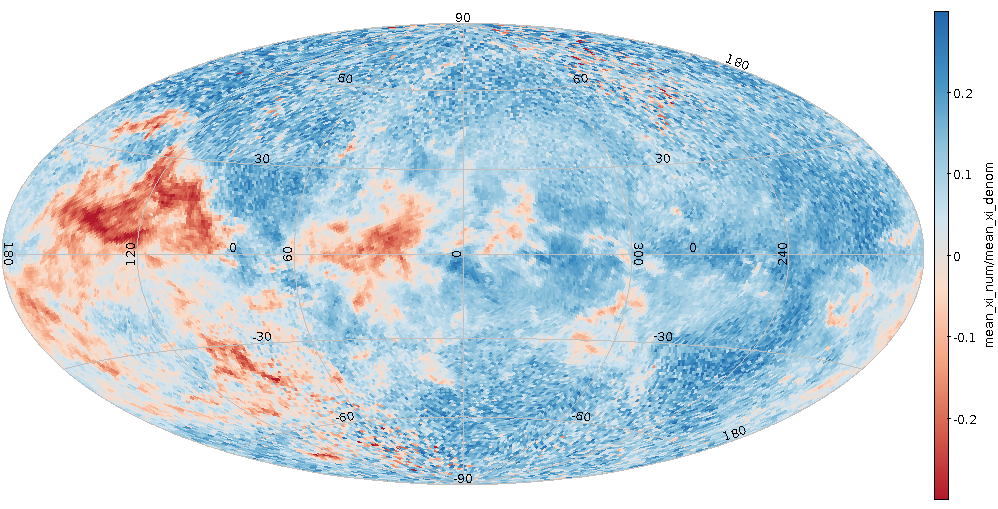
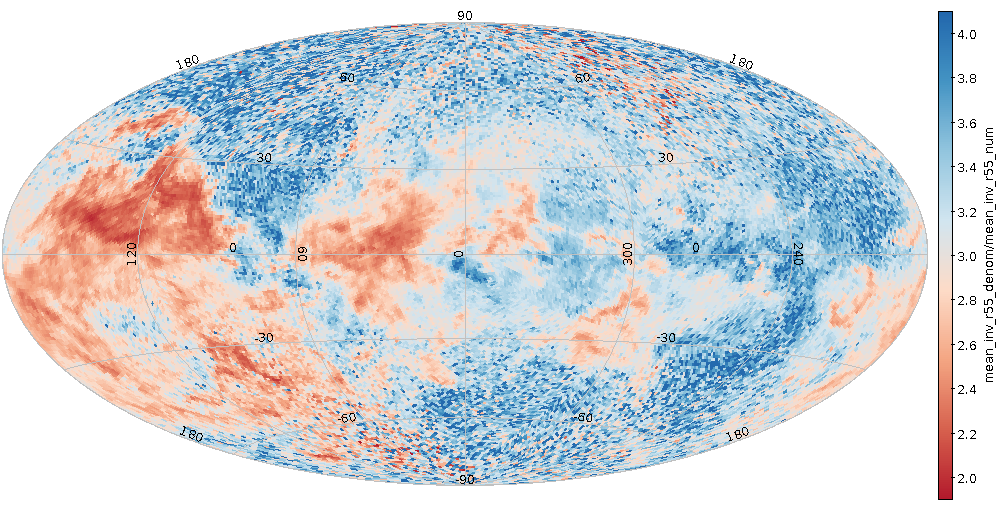
Note that in regions of low extinction, the measurements of ξ (and
consequently R(55)) are noisy, and should be treated with caution.
![[Operator logo]](/static/img/logo_medium.png)